


After being lost for over a month, a Golden Retriever may gradually become tired and less inclined to keep moving. If they find a place where food is consistently available, they often settle in that area.
Once settled, they are often taken in either by animal control or by nearby residents. If your dog is taken in by a local resident rather than animal control, they may no longer appear in public places, making sightings much less likely.
That’s why you should not only check the latest listings of animals currently housed at the local animal control center, but also focus on sharing information and gathering tips to find out whether someone in the area may have taken your dog in.
We hope you and your dog will be safely reunited soon.
In the beginning, dogs usually keep moving in an attempt to return to their owner. However, as time passes, finding water and food becomes their top priority.
As the days go by and their hunger increases, they are more likely to be picked up by animal control or taken in by someone in the community.
Please understand that each dog is different, and factors such as their living environment, personality, and age can all influence their behavior.
1. Psychology and Behavior of a Dog When They Go Missing
Golden Retrievers may bolt from home when startled by loud sounds like thunder or fireworks. During walks, they may take off in response to sudden events―such as being barked at by another dog, startled by a bicycle, or chasing a cat.
Once the initial excitement fades, they may become anxious about being alone in an unfamiliar place. They often try to return to their owner or home, wandering in search of familiar landmarks.
Golden Retrievers are large and have strong endurance, so they may travel more than 10 kilometers on the first day they’re missing.
Indoor dogs may be able to find their way back on their own if they go missing very close to home or along their usual walking route. However, if they stray far from familiar areas, it’s unlikely they will return by themselves.
The distance a lost Golden Retriever can travel in a day is about 5 kilometer, though this depends on age and condition. If they lose their sense of direction, they may not travel in a straight line, instead wandering randomly or circling the same area repeatedly. Friendly dogs tend to approach people, while more cautious dogs head toward quiet, unpopulated places. They may head toward rivers or other places where water is available.
Because they are large dogs, they may be captured by authorities for public safety. If the dog is friendly, someone in the community may report them, and they may be taken in by the police or an animal control center. On the other hand, if the dog is fearful and barks defensively, they may run away when someone tries to catch them, and even after they’ve been located, it may still take time to safely capture them.
2. Changes in Behavior Over Time
In the early days, lost dogs often continue moving in an attempt to return home. However, as hunger becomes more intense, finding food becomes their top priority.
Even if they’re trying to head home, they will lose energy if they can't find food. Searching for food also takes time, which reduces how far they can travel in a day. Unlike in the past―when people often fed strays or left accessible scraps―today’s urban environment makes long-distance survival much harder for dogs.
After a month or more, the physical toll of living outdoors starts to build. Once a dog finds a place where they can consistently find food, they tend to settle there. In many cases, they are eventually rescued by local residents or picked up by animal control.
3. Rescued by Animal Control or Locals
Dogs walking alone are highly noticeable and are frequently reported and picked up by local police or animal control. If your contact information is written on their collar, you may be contacted quickly.
There have also been cases where a sick or injured dog was rescued by a kind passerby and taken to a nearby veterinary clinic. Sometimes, they are cared for at someone’s home without any report being filed.
A dog’s behavior when they go missing can vary depending on their age.
Based on our search experience, we would like to share how dogs of different age groups tend to behave when they go missing.
Of course, please keep in mind that a dog’s behavior is also influenced by factors such as how long they’ve been missing, their personality, physical condition, and the surrounding environment―so individual differences are always to be expected.
1. Puppy Stage (Under 1 Year)
Puppies are full of curiosity and act impulsively, showing interest in everything around them.
However, once the excitement fades and they realize they don’t know how to get home, they may suddenly become anxious and start moving around unpredictably.
Because of their friendly nature, some puppies may approach people or other dogs on their own and end up being rescued.
2. Adult Stage (1–6 Years)
At this age, dogs are physically and mentally active and tend to move around energetically, even when lost.
They may explore areas that smell of other dogs or investigate new places out of interest. Rather than moving in a straight line, they often stop and sniff various locations as they go.
Because of their energy and mobility, people often assume they’ve traveled far, but in reality, they are sometimes found much closer than expected.
3. Senior Stage (7 Years and Older)
As dogs reach their senior years, they tend to stay calm and make thoughtful decisions, even when lost.
Since they usually don’t feel physically weak yet, they are more likely to keep moving―either trying to find their way home or searching for a place where they can get food more reliably, rather than staying in one spot.
4. Advanced Senior Stage (12+ Years for Small and Medium Dogs / 10+ Years for Large Dogs)
In this stage, many dogs experience reduced stamina and tire easily, making their daily travel distances shorter.
While they are less driven by marking behavior or interest in other dogs compared to when they were younger, they may move in a more direct path―sometimes ending up farther than expected.
If the dog went missing due to cognitive decline (such as dementia), they may wander slowly and continuously, which can also increase the distance traveled.
Dogs with weakened legs or joints often don’t travel far and tend to stay near rivers or other places where water is available.
Understanding these age-related tendencies can help guide your search strategy and improve your chances of finding your lost dog.
If a dog on medication starts to feel unwell as the effects of the medicine wear off, they will often crawl into a dark, narrow, and secluded place where people or other animals are unlikely to come, in order to wait and recover.
For dogs whose symptoms return quickly after the medication wears off, they are usually unable to travel far and instead try to find a safe hiding spot very close to where they went missing.
When a dog undergoing medical treatment goes missing, many owners tend to assume the worst―thinking the dog may have already passed away because their condition deteriorates quickly without medication.
However, there have been many cases where a dog was found several days later with no serious health issues. It’s important to stay calm and continue your search step by step.
There have also been cases where a sick or injured dog was rescued by someone driving by and taken to a nearby veterinary clinic.
For this reason, be sure to bring your Lost Dog Flyers to all veterinary clinics within at least a 10-kilometer radius, and if possible, ask if they can post the flyer in their waiting area.
The distance a lost Golden Retriever can travel in a day is about 5 kilometer. However, after being lost for over a month, they may gradually become tired and less likely to keep moving. Once they settle in a certain area, they are more likely to be taken in by nearby residents.
As a guideline, increase the number of locations where you post Lost Dog Flyers to cover a 30-kilometer radius of the location where they were last seen―the likely upper limit of your dog’s range.
Unlike cats, a dog wandering alone is very noticeable, so including the following information is usually sufficient for a lost dog flyer:
- Your dog’s name
- Photos that clearly show their appearance, coat color, and pattern
- A photo that shows their size
- The date they went missing
- The location where they went missing
- Your contact information
- A request for people to take a photo if they see your dog
- If possible, ask them to safely contain your dog―or, if that’s not feasible, to contact you without chasing them
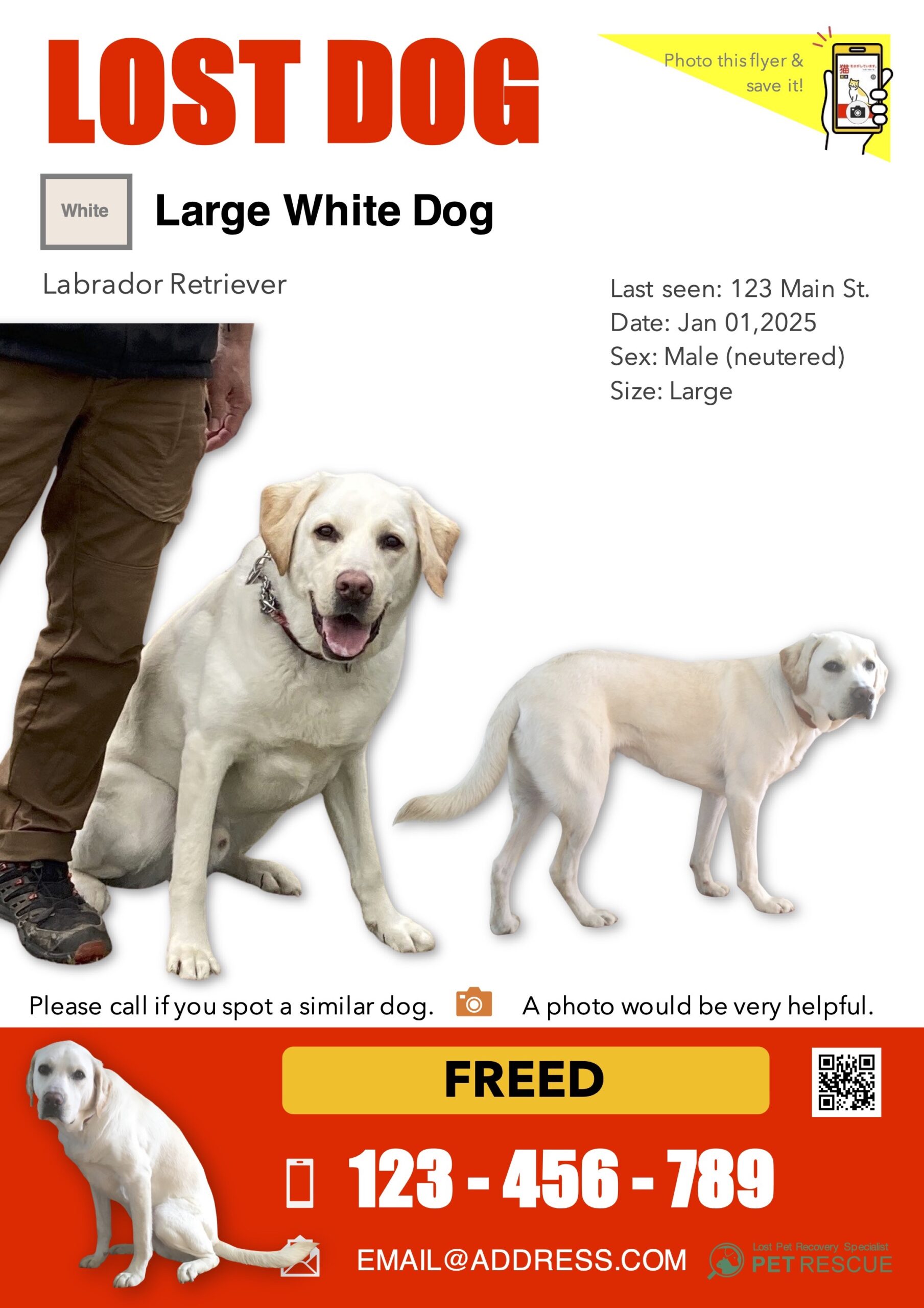
Quickly post Lost Dog Flyers throughout the search area to reach a wide range of people and collect as many sightings as possible.
Note: Do not post flyers on utility poles, trees, guardrails, or walls without permission. Always get approval before posting.
1. How Far to Post Flyers
Travel distance depends on the dog’s breed and age, but as a general guide, lost dogs may move the following distances in a day:
- Extra-small dogs: up to 0.5 km
- Small dogs: up to 1 km
- Medium to large dogs: up to 5 km
Determine how far to post flyers based on how many days have passed since your dog went missing.
Keep in mind that dogs don’t always move in a straight line―they may wander in circles or stay in one area. If they find a place with a regular food source, they may settle there.
Instead of expanding the flyer posting range indefinitely, set a reasonable maximum radius from the spot where your dog was last seen based on the following guideline:
- Extra-small dogs: up to 5 km
- Small dogs: up to 10 km
- Medium to large dogs: up to 30 km
2. Where to Post Flyers
Post flyers in places where many people gather, such as:
- Convenience stores
- Grocery stores
- Restaurants
- Veterinary clinics
- Pet supply stores and grooming salons
3. Managing Your Flyers
When posting at a facility, always inform the manager how long you plan to keep the flyer up.
Keep a record of all the locations where flyers are posted by marking them on a map.
Sharing information on social media can be helpful for quickly letting many people know that your dog is missing.
Post about your lost dog and ask others to share the information.
Also check for sightings of your Lost Dog and updates on lost pet websites and social media pages.
Sharing information on social media can be helpful for quickly letting many people know that your dog is missing.
When posting, be sure to include the following information and ask others to share it:
- Your dog’s name
- Photos that clearly show their appearance, coat color, and pattern
- A photo that shows their size
- The date they went missing
- The location where they went missing
- Your contact information
- A request for people to take a photo if they see your dog
- If possible, ask them to safely contain your dog―or, if that’s not feasible, to contact you without chasing them
In addition to posting, search for other posts about found or sighted dogs in your area.
If you find one that might be your dog, contact the person who made the post.
However, because posts can be seen by a wide and unspecified audience, there are also some downsides. In addition to genuine sightings, you may begin receiving personal stories about others’ lost dogs or repeated unsolicited advice. Responding to these can take up valuable time and energy. In some cases, you may even receive unkind or critical comments. To avoid emotional fatigue, it’s often best to ask someone else to manage social media communications on your behalf.
The distance a lost Golden Retriever can travel in a day is about 5 kilometer. However, after being lost for over a month, they may gradually become tired and less likely to keep moving. Once they settle in a certain area, they are more likely to be taken in by an animal control center.
As a guideline, report your Lost Dog to the animal control center that oversee areas within a 30-kilometer radius of the location where they were last seen―the likely upper limit of your dog’s range.
Note: Procedures and agency responsibilities may vary by country or region. Please check with your local authorities for accurate guidance.
1. Police Departments
In most areas, police departments do not have the facilities to house or care for animals. If someone brings a lost dog to the police station, they will often refer them to the local animal control center.
In some regions, the police may keep records of dogs that have been brought in. It’s worth checking whether your dog may be listed.
2. Animal Control Centers
If a dog is taken to an animal control center, they will first receive any necessary medical care. Staff will scan for a microchip, and if owner information is registered, they will attempt to make contact.
If the dog is unidentifiable, they will be held and posted as lost for a designated holding period. Be sure to check the center’s lost-and-found listings regularly.
If no one claims the dog during the holding period, the cat may be put up for adoption or transferred to a rescue organization.
3. Public Works Departments (Road Cleaning Services)
Sadly, if a dog is found deceased―such as from being hit by a car―it may be collected and disposed of by the city’s public works department responsible for road maintenance.
In such cases, remains are often cremated within two to three days, and no official record may be kept. It’s important to contact the department promptly if there is a possibility your dog was involved.
4. Veterinary Clinics
Although not government-run, veterinary clinics often receive lost dogs that have been rescued due to injury or illness.
There have been cases where a passerby found a dog in poor condition and brought them to a clinic near their home. For this reason, it is strongly recommended that you take your Lost Dog Flyer to all clinics within a 10-kilometer radius and ask if they would be willing to display it in their waiting area.
Also check the latest listings of animals currently housed at the local animal control center.
There have been cases where lost dogs were rescued due to injury or exhaustion and brought to a veterinary clinic.
Take your Lost Dog Flyers to all clinics within a 10-kilometer radius of the location where they were last seen, and ask if they would be willing to display one in their waiting area.
When you receive a sighting report, go to the location to check the area and safely recover your dog.
Sightings calls often come unexpectedly. To avoid panicking when you receive one, it’s helpful to prepare in advance by writing down the following items in a notebook or memo app that you can easily access at any time.
When you receive a sightings call, start by sincerely thanking the caller, then ask for details about the sighting.
1. Ask for details about the sighting―when they saw the dog (and how long they’ve been seeing them), the exact location, what the dog was doing at the time, and which direction they were heading.
2. If they have a photo, ask them to send it via SMS or another messaging method.
3. Ask for the caller’s name, and if possible, request permission to contact them again. Also, ask if they would be willing to take a photo if they see the dog again.
4. Save the caller’s information in your phone contacts with a clear label such as "Sighting Info – Mr. Yamada." This way, if they call again, you’ll immediately recognize who it is.
5. If there’s a chance your dog is still in the area, explain how they tend to behave―such as barking, biting, or running away―and, if appropriate, kindly ask the caller if they’d be willing to try catching your dog or keeping an eye on them until you arrive―only if they feel safe doing so.
What You’ll Need: Flashlight, your dog’s favorite treats, leash, Lost Dog Flyers, food, trail camera
1. Go to the Sighting Spot Right Away
When you receive a sightings call, go to the reported location as quickly as possible and search the area―call your dog’s name and coordinate the search with others if possible.
Friendly dogs tend to approach people, while more cautious dogs head toward quiet, unpopulated places.
2. Gather Sightings
If you don’t find your dog right away at the reported location, hand out Lost Dog Flyers and speak with nearby residents.
Also post Lost Dog Flyers around the sighting area and share the information on social media to encourage sightings.
3. Repeated Sightings in One Areas
Lost dogs often settle in areas where they can consistently find food.
If your dog is repeatedly spotted in the same area, there is a high chance they have found a steady food source nearby. Search for places where food may be available―such as places where trash is regularly put out for collection, feeding spots for stray cats, or anywhere residents might be giving them food.
Dogs also tend to go down to riverbanks in search of water, so if there is a river nearby, be sure to search the surrounding area.
4. Use a Trail Camera
If the dog is extremely fearful, they may become overwhelmed by people or their surroundings. Instead of continuing to walk, they may crawl into a dark, narrow, and deep hiding spot.
Use a trail camera to monitor areas that are hard to check visually.
In the evening, set out food and a trail camera in a spot where the dog might be hiding. Check the footage the next morning.
If their wariness outweighs their hunger, they may not appear right away even if they’re nearby. So keep the trail camera in place for at least two days.
5. Check with Local Authorities
After being spotted, your dog may be reported and picked up by the police or animal control center.
Be sure to check with the appropriate local authorities.
What You’ll Need: your dog’s favorite treats, toys, leash
1. Don’t Shout Their Name or Chase Them
When you spot your Lost Dog, shouting their name and rushing toward them may cause them to panic and run away. They may be startled by your unusual behavior or may have become more cautious due to the stress of being separated from you. Instead of running up to them, call their name in a calm, familiar voice from a distance to help them recognize you. Once they seem to acknowledge you, slowly approach to bring them to safety.
2. If They Mistake It for Play
In some cases―especially right after they’ve gone missing―dogs may misinterpret being chased as play and run off even farther. If this happens, don’t pursue them. Instead, take a few steps back while calling them to encourage them to come toward you.
3. Traffic Hazards
One of the most critical safety concerns when calling your dog back is traffic. If you see your dog across a road, always check for oncoming cars before calling them. Never call them when vehicles are passing through, as they may run straight into the road without looking, which is extremely dangerous.
4. Once You’ve Caught Them
Once you’ve safely recovered them, check that their collar is secure. They may have lost weight and the collar might now slip off easily. If so, tighten the collar before attaching the leash. If your dog seems excited, put a harness on them and use a double leash setup to prevent them from escaping again.
When you recover your lost dog, take them to a veterinary clinic as soon as possible to ensure they receive any necessary medical care.
1. If You Recover Your Dog at Night
If your dog is injured or severely weakened, take them to a 24-hour emergency animal hospital for immediate care.
2. Their First Meal
In some cases, dogs may not have eaten anything for several days. If they are severely underweight, offer easily digestible food―such as softened dry food or wet food―to avoid putting strain on their stomach.
3. Even If They Seem Fine
Even if your dog appears to be in good condition, take them to your regular veterinarian for a check-up. Ask the vet to examine them for dehydration, external injuries, dental or claw damage, fleas, ticks, parasites, and signs of infection.
4. If They Were Bitten in a Fight
If your dog was bitten in a fight, swelling or infection may not appear until a few days later. Monitor their condition closely, and if you notice any swelling or pus, bring them to the vet immediately.
5. If You Were Bitten or Scratched During Capture
If you were bitten or scratched while capturing your dog, there may be a risk of infection. Rinse the wound thoroughly under running water right away. If swelling or other symptoms develop, seek medical attention without delay.
Once your lost dog has safely returned home, please take the time to let everyone who provided sightings or helped with the search know, and thank them for their support.
If you posted Lost Dog Flyers with permission, attach a note that says "Found" and take them down after about 3 days. Many people in your community were likely concerned and hoping for a happy outcome.
Notify any places where you filed a lost report―such as the local police station, animal control center, public works department (road cleaning division), and veterinary clinics―that your dog has been found.
We’re so glad your dog is home safe.
Here’s to many more happy moments with your beloved dog by your side!
A trail camera is a motion-activated device designed to automatically capture photos and videos of wildlife outdoors. It works both during the day and at night.
When an animal―such as a dog―comes near, the camera detects the movement and records images or video accordingly.
Trail cameras are battery-operated, waterproof, and store the captured footage on an internal memory card.
These cameras are especially useful for checking whether your missing dog is coming to eat the food you’ve left out or for monitoring activity around a Trap Cage.
Because they operate silently and without revealing any human presence, they provide continuous overnight surveillance―making them a highly effective tool in the search for a lost dog.


