


When you visit the sighting location, you may come across a cat with a coat color or pattern similar to your cat’s.
However, just because there’s a similar-looking cat doesn’t necessarily mean your cat isn’t there. Use a trail camera to capture footage of the cats in the area and check the footage carefully to confirm.
To reduce future reports of similar-looking cats, update your Lost Cat Flyer to highlight the differences between your cat and the others seen in the area. Then redistribute the updated flyers throughout the neighborhood.
We hope you and your cat will be safely reunited soon.
To confirm whether your cat is there along with the similar-looking cat, use a trail camera.
In the evening, set out food and a trail camera near the facilities or homes your cat may have darted into, focusing on potential hiding spots nearby. Check the footage the next morning.
If your cat is still more cautious than hungry, they may not show up right away even if they’re nearby. So keep the trail camera in place for at least two days.
1. Use your cat’s favorite food as bait. Adding a strong-smelling item, such as grilled fish, can also help attract them. Place a generous amount so it doesn’t run out even if other cats come to eat.
2. During bug season, place the food on a raised dish inside a shallow dish of water to deter slugs and insects. You can also cover the food with mesh to prevent flies. The goal is not to feed your cat but to attract them with the smell and capture them on a trail camera, so it’s fine if the food is somewhat difficult to eat.
3. Do not scatter other food or used your cat’s litter around the feeding area.
4. Set up a trail camera facing the food so you can see which cats are coming to eat. Without a trail camera, you won’t know which cat is visiting, so be sure to use one together with the food.

Note: Trail camera setup procedures may vary depending on the model, so please refer to the user manual for detailed instructions.
1. Camera Settings
- Video: 2-minute recording duration, sound on
- Motion sensor sensitivity: Medium
2. Camera Placement
Position the trail camera about 1–2 meters (3–6 feet) away from the food or Trap Cage. Make sure the cat’s full body is visible from the side so you can clearly identify their tail shape and coat pattern. Some cameras may overexpose the image at night if placed too close, making the cat appear completely white. Be sure to test the camera distance in advance to avoid overexposure at night.
3. Getting Permission
If placing the camera on someone else’s property or at a feeding spot, always obtain permission beforehand.
Label the camera with the purpose, installation period, and your contact information.
4. Theft Prevention
If setting up in a public area, place the camera somewhere less noticeable―such as tucked into a bush or behind an object.
We also recommend using a lockable cable to secure it to a post or other fixture.
5. Installation Period
Set up the camera at sunset and check the footage the following morning.
Since your Lost Cat may not appear right away, keep the camera in place for at least two nights.
If there are no sightings after two days, move the camera to a different location.
6. If there are stray or community cats in the area
In areas where stray or community cats are present, it’s highly likely that there’s a feeding spot nearby. Stray cats don’t usually stay in one place unless they have access to a steady food source, so their presence often indicates someone is providing food in the area.
Even if the person feeding the cats says, "Your cat hasn’t come here," keep in mind that they may not have noticed. Politely ask for permission to set up a trail camera for at least two days to check whether your cat has visited the spot.
Trail Camera: Cat Approaches Trap Cage
If your cat appears on the trail camera, go to that location during the same time of day they were recorded and search for them.
When you find your cat, avoid making sudden movements, as rushing toward them may cause them to run away. Stay calm, observe their behavior carefully, and slowly and gently approach to bring them to safety.
What You’ll Need: Your cat’s favorite treats, a Cat Carrier
1. When you find your lost cat, first crouch down low and calmly call their name in a steady voice while observing their behavior.
2. If your cat doesn’t appear tense or try to run away when you call their name, stay low and slowly approach while continuing to speak softly. If they come up to sniff your outstretched fingers, you may be able to gently touch and safely pick them up by hand. Offering their favorite treat can also help ease their tension.
3. If you successfully catch them with your bare hands, immediately place them in a Cat Carrier to prevent them from slipping out of your arms and escaping. If you don’t have a carrier, a mesh laundry bag can be used as a substitute.
4. If your cat starts to back away with their back arched as you approach―or sniffs your fingers but still seems wary―remain crouched and wait patiently until they relax. It may take 30 minutes or more, but give them time to feel safe.
5. If your cat doesn’t calm down, step away from the area for now. Trying to force a capture may scare them into fleeing again, which means having to start locating their whereabouts all over again. In such cases, use a Trap Cage for a more reliable capture.
If your cat has hidden in a spot and won’t come out, block off the surrounding area with bricks or other barriers to prevent escape. Then, set up the Trap Cage at the exit.
If you’re not completely sure whether the cat captured on the trail camera is yours, use a trap cage to confirm their identity.
If a similar-looking cat is caught in the trap cage, take photos of the features that distinguish them from your cat before releasing them.
These photos will help you update your Lost Cat Flyer to highlight the differences between your cat and the look-alike.
Here’s how to use a commercially available trip-plate trap (spring-loaded trap) to capture your cat.
Trap cage usage may vary depending on the manufacturer, so please refer to the instruction manual for details.

1. Establishing a Feeding Routine
- Only place the trap cage after you’ve confirmed where your cat is.
If you set it too early, it may catch other cats, making management difficult and possibly leading to neighborhood conflicts.
- Once you’ve located your lost cat, place food at that spot at the same time each day to get them used to coming.
Set up the trap cage only during the time they usually come to eat―this helps reduce the chance of catching other cats.
2. Getting Permission
- If placing the trap on property you don’t own, obtain permission from the landowner.
- If there are outdoor-access cats nearby, ask their owners to keep them inside during trapping hours.
- If there are community cats nearby, ask the caretakers to feed them away from the trap and in large enough amounts so they’re not tempted.
- Label the trap cage with the purpose, installation period, and your contact information.
3. Managing Feeding Spots
Cats won’t go into a trap unless they’re hungry.
If someone nearby is feeding cats, explain your situation and ask them to manage their feeding schedule so your cat doesn’t eat there.
4. Safety Check and Cleaning Before Use
- Make sure there are no sharp edges that could injure your cat. If there are, file them down.
- Check that the sliding gate at the back cannot be pushed upward by the cat. If it can be opened even with light pressure, secure it with cable ties.
- Confirm that stepping on the trip plate causes the door to close immediately.
If the door shuts from slight vibrations (like shaking), adjust the hook to secure it more firmly.
- If the trap smells like other cats, deodorize it thoroughly with spray or rinse with water.
5. Making the Trap Cage More Comfortable
- Cover the trap with a sheet to block the mesh and create a dark, calm space.
Using a sheet that has your cat’s scent can help them feel safer.
Place a pee pad or similar material inside to make it easier to walk on.
- Use your cat’s favorite food as bait. Strong-smelling items like grilled fish can also help.
- During bug season, place the food on a raised dish inside a shallow dish of water to deter slugs and insects.
6. Trap Placement
- Choose a quiet location where people won’t disturb the trap.
Place the trap cage parallel to, but slightly off to the side of a narrow path the cat is likely to use―this is more effective than placing it directly in the middle.
- Even if the food is tempting, cats may be wary of an unfamiliar trap.
Place it near bushes, cars, sheds, or under the deck so they can observe it calmly before approaching.
Cautious cats often watch for a while before deciding it’s safe.
- Place a small amount of food just in front of the trap entrance.
Even if the cat doesn’t enter, if the food disappears, you’ll know an animal came.
Do not place any other food nearby―if your cat satisfies their hunger there, they may not risk entering the trap.
7. Use a Trail Camera to Monitor
If your cat doesn’t get caught in the trap cage, set up a trail camera facing the trap.
This helps determine whether they are approaching but avoiding it, or not coming at all.
8. Trap Monitoring and Safety
- Depending on your cat’s personality and living environment, it’s best to set the trap from evening to early morning when it’s quiet.
- Do not use the trap during hot daytime hours in summer―there’s a serious risk of heatstroke.
- Once the trap is set, leave the area so your cat doesn’t sense your presence.
- If there are signs of human activity around the trap, the cat may avoid it.
Check whether the door is closed by shining a flashlight from a distance.
- If an animal remains trapped too long, they may be injured or exhausted.
Check from a distance every 3 hours. If the door is still open, leave quietly.
- If another animal is accidentally caught, release it immediately while avoiding injury to either party.
Take care not to be scratched on your wrists or arms, as there’s a risk of infection.
If scratched or bitten, rinse the wound thoroughly under running water and seek medical attention.
- If the trapped cat looks similar to yours, take clear photos of any distinguishing features before releasing them.
These photos may help confirm or rule out future sightings reported in response to your Lost Cat Flyers.
9. If You Catch Your Cat
- If you successfully catch your cat, do not open the trap on the spot.
Take them home, close all doors and windows, and only then release them indoors.
- If your cat appears injured or weak, keep them in the trap cage and take them to a veterinary clinic right away.
To reduce future sightings of similar-looking cats, update your Lost Cat Flyer.
Include features that help distinguish your cat from look-alikes―such as their ear tip, tail shape, or pattern.
Also, to increase the reliability of sightings, be sure to include a note on the flyer that says, "If possible, please take a photo."
When a cat goes missing, many owners tend to fill their Lost Cat Flyer with lots of photos and text in an effort to convey as much information as possible. However, this can actually be counterproductive. If the flyer is too crowded with details, people may not remember anything clearly. As a result, they might not contact you even if they see your cat, or they may report sightings of cats that only share a similar color.
For example, if your brown tabby cat has a kinked tail and an ear tip on the right ear, you should prominently feature a simple description like "Brown Tabby Cat with Kinked Tail," along with a photo that clearly shows the tail and the ear tip. By omitting other less essential details, you help people remember the key traits: "a brown tabby cat with a kinked tail."
Also, to increase the reliability of sightings, be sure to include a note on the flyer that says, "If possible, please take a photo."
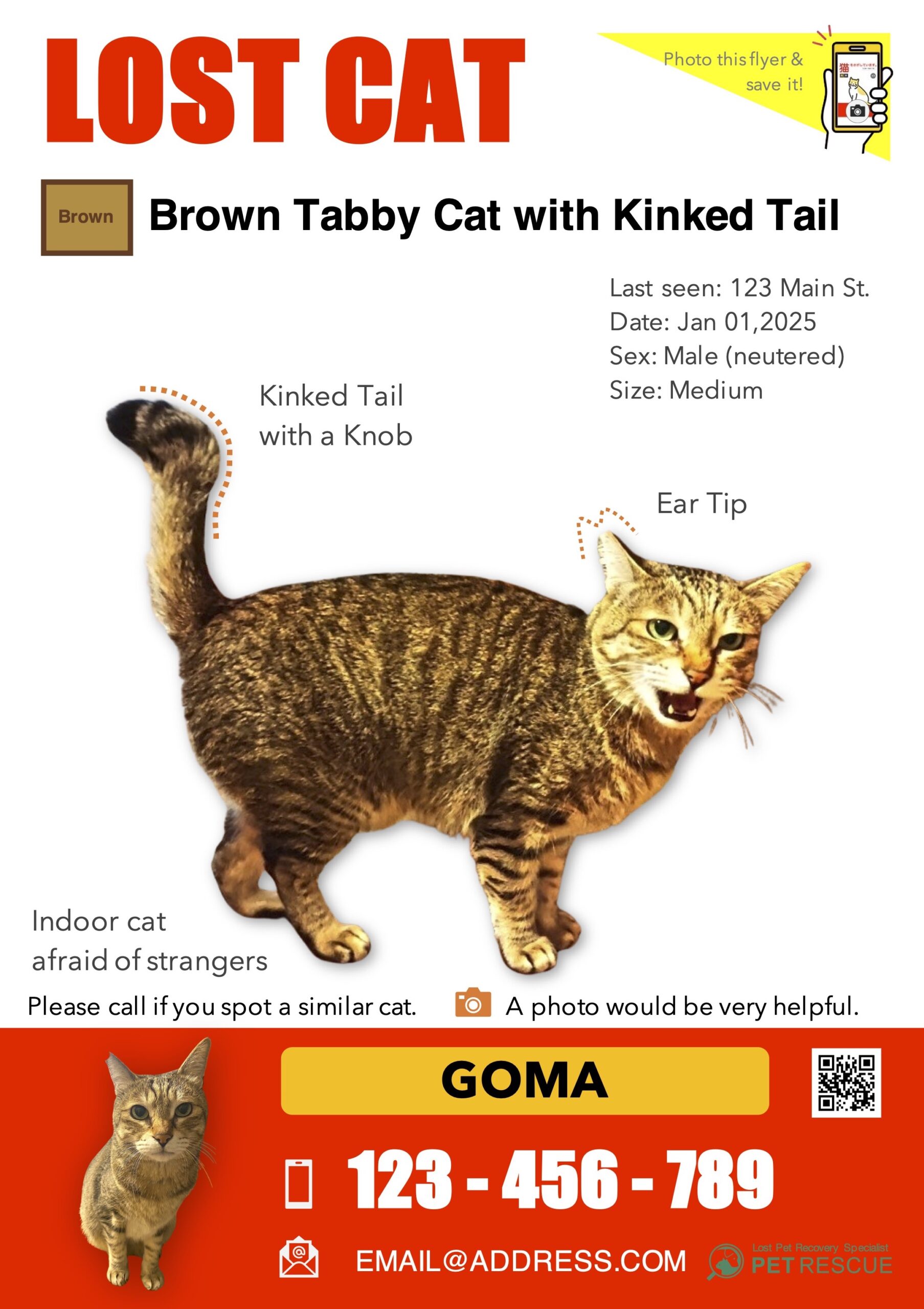
As a guideline, redistribute the updated Lost Cat Flyers to every household within a 100-meter radius of the sighting location―without missing a single home.
1. During the day, distribute Lost Cat Flyers to every household near the place where your cat went missing, starting close by and making sure not to skip a single home. Speaking with residents can take time, so focus on placing the flyers directly into mailboxes. As you post the flyers, also search visually around front yards and other visible areas.
2. Instead of distributing flyers at random, go block by block―covering one block bordered by roads at a time. Mark each household you’ve posted to on a map, and also note locations where a cat might be hiding, such as vacant homes, along with any known feeding spots or outdoor cat activity. This will help you build a detailed search map for your lost cat.
3. Until you receive confirmed sightings, postpone distributing flyers across wide roads or rivers, and instead expand the flyer coverage area evenly in all directions from the point where your cat went missing.
When you receive a sightings call, ask for details about the sighting.
If they have a photo, ask them to send it via SMS or another messaging method. Also, let them know some key features of your cat, and kindly ask them to take a photo if they see the cat again, making sure to capture the features you described.
Sightings calls often come unexpectedly. To avoid panicking when you receive one, it’s helpful to prepare in advance by writing down the following items in a notebook or memo app you can easily access at any time.
When you receive a sightings call, start by sincerely thanking the caller, then ask for details about the sighting.
1. Ask for details about the sighting―when they saw the cat (and since when they’ve been seeing them), the exact location, what the cat was doing at the time, and which direction they were heading. When asking about the cat’s appearance, do not lead the conversation with questions like "Did they have an ear tip on the right side?" Instead, let the caller describe what they remember in their own words.
2. If they have a photo, ask them to send it via SMS or another messaging method. Also, let them know some key features of your cat, and kindly ask them to take a photo if they see the cat again, making sure to capture the features you described.
3. Ask for the caller’s name, and if possible, request permission to contact them again. Also, ask if they would be willing to take a photo if they see the cat again.
4. Save the caller’s information in your phone contacts with a clear label such as "Sighting Info – Mr. Yamada." This way, if they call again, you’ll immediately recognize who it is.
If your cat does not appear on the trail camera set up at the sighting location, assume they were probably not at that location. If you receive any future sightings from that area, kindly explain the situation and thank the caller politely.
If you receive a credible sighting, go to the location and search.
Even if you manage to find your cat and pick them up with your bare hands, there is a risk they may slip away and escape again on the way home.
This can happen even just 10 meters from your house.
Carrying a cat securely in your arms without them escaping is extremely difficult―even over a short distance.
Once you have caught your cat, place them in a Cat Carrier immediately to prevent another escape.
If you do not have a Cat Carrier, you can use a mesh laundry bag or a similar alternative to safely contain them.
A trail camera is a motion-activated device designed to automatically capture photos and videos of wildlife outdoors. It works both during the day and at night.
When an animal―such as a cat―comes near, the camera detects the movement and records images or video accordingly.
Trail cameras are battery-operated, waterproof, and store the captured footage on an internal memory card.
These cameras are especially useful for checking whether your missing cat is coming to eat the food you’ve left out or for monitoring activity around a Trap Cage.
Because they operate silently and without revealing any human presence, they provide continuous overnight surveillance―making them a highly effective tool in the search for a lost cat.
There are various types of trap cages, but when capturing a lost cat, a trip-plate trap (spring-loaded trap) is most suitable.
This type of trap works by placing cat food at the back to lure the cat inside. When the cat steps on the trip plate, the spring mechanism automatically triggers the door to close.
If the trap is too small, the door may not fully close even after being triggered, which can result in the cat escaping―sometimes with its tail or hind legs caught.
To reduce the risk of escape or injury, choose a trap approximately 76 cm long × 25 cm wide × 25 cm high.


