


An outdoor-access cat may end up outside their usual territory while chasing or being chased by other cats when in heat, and they can lose their sense of direction and no longer know how to get home.
Because homing ability varies from cat to cat, it’s common for them to become lost just by entering an unfamiliar area or crossing a wide road or bridge.
If you can’t find your cat nearby, start distributing Lost Cat Flyers before they leave their usual territory.
Once their heat cycle ends, they may unexpectedly come back after a few days. However, it’s also possible that they’re in trouble and unable to come home.
Instead of waiting and hoping they’ll return on their own, take an active role in searching for them.
We hope you and your cat will be safely reunited soon.
After getting outside, cats often move around in places that are hard to see from the street―such as backyards or fences between houses―especially during the first few days.
To ensure that anyone who spots them can contact you, be sure to distribute Lost Cat Flyers to every household in your block and the adjacent blocks without missing any homes.
Cats often hide within residential properties or move around in areas that are difficult to see from the street, such as backyards or fences between houses. As a result, it’s more likely that a resident will spot your cat on their property than you will by searching from the street.
If your cat has started to roam and the search area has widened, simply walking around becomes a matter of chance. That’s why it’s important to not only search visually from the street but also distribute Lost Cat Flyers to every household in the area. Even if you don’t see your cat yourself, the flyers create a network of residents who can contact you if they spot them.
By distributing flyers thoroughly, without leaving gaps, you create a local network of awareness―making it more likely that your cat will be seen wherever they go.
If someone has taken in your cat because they were sick or injured, the flyer can help them realize the cat is being searched for. Likewise, if your cat has started visiting a feeding spot, someone may recognize them from the flyer and reach out.
Many cats are successfully found and brought home thanks to sightings reported through Lost Cat Flyers.
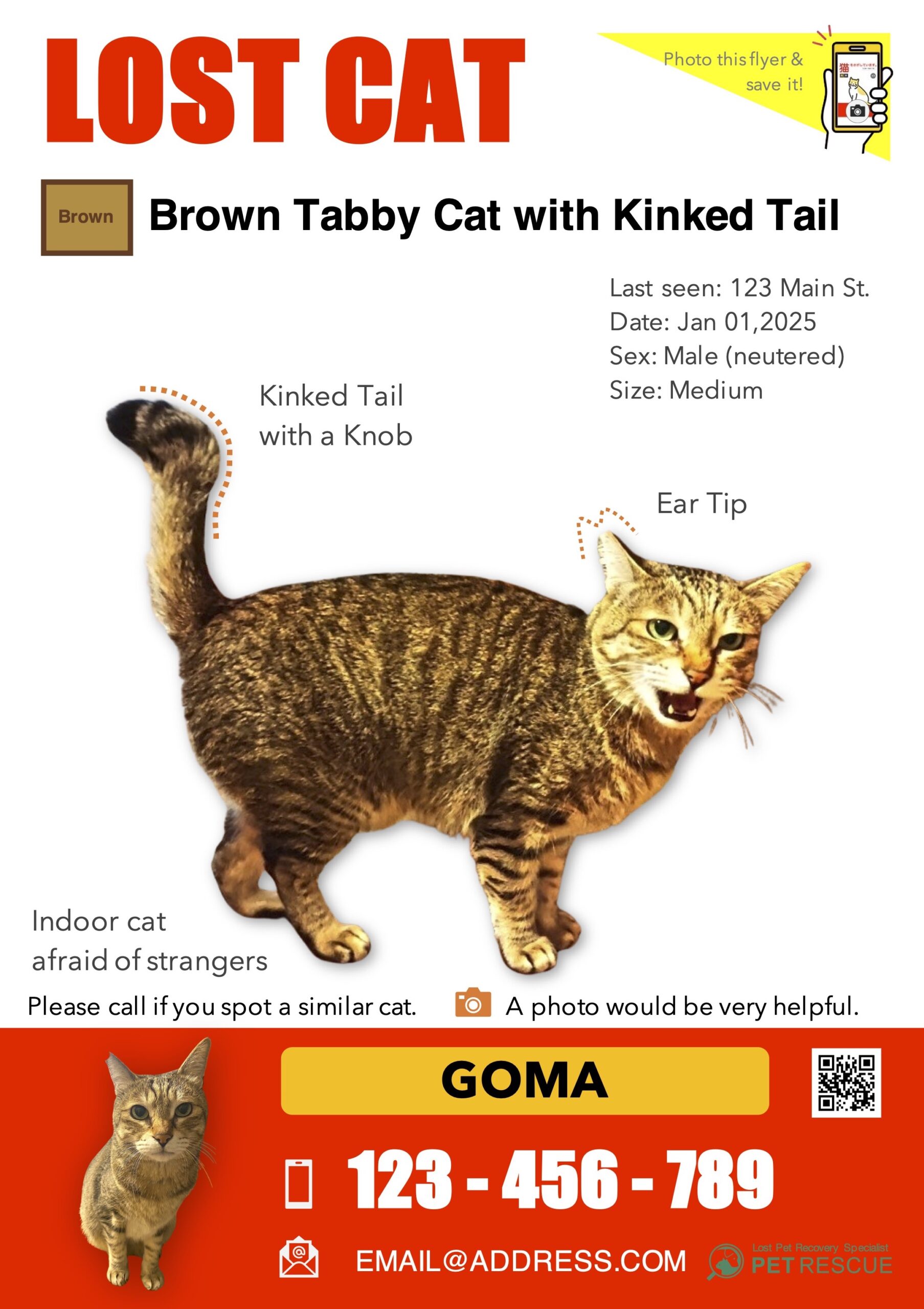
When a cat goes missing, many owners tend to fill their Lost Cat Flyer with lots of photos and text in an effort to convey as much information as possible. However, this can actually be counterproductive. If the flyer is too crowded with details, people may not remember anything clearly. As a result, they might not contact you even if they see your cat, or they may report sightings of cats that only share a similar color.
For example, if your brown tabby cat has a kinked tail and an ear tip on the right ear, you should prominently feature a simple description like "Brown Tabby Cat with Kinked Tail," along with a photo that clearly shows the tail and the ear tip. By omitting other less essential details, you help people remember the key traits: "a brown tabby cat with a kinked tail."
Also, to increase the reliability of sightings, be sure to include a note on the flyer that says, "If possible, please take a photo."
1. During the day, distribute Lost Cat Flyers to every household near the place where your cat went missing, starting close by and making sure not to skip a single home. Speaking with residents can take time, so focus on placing the flyers directly into mailboxes. As you post the flyers, also search visually around front yards and other visible areas.
2. Instead of distributing flyers at random, go block by block―covering one block bordered by roads at a time. Mark each household you’ve posted to on a map, and also note locations where a cat might be hiding, such as vacant homes, along with any known feeding spots or outdoor cat activity. This will help you build a detailed search map for your lost cat.
3. Until you receive confirmed sightings, postpone distributing flyers across wide roads or rivers, and instead expand the flyer coverage area evenly in all directions from the point where your cat went missing.
If you find your cat but they won’t come out of hiding or seem likely to run away when you approach, use a Trap cage to safely and successfully capture your cat.
Here’s how to use a commercially available trip-plate trap (spring-loaded trap) to capture your cat.
Trap cage usage may vary depending on the manufacturer, so please refer to the instruction manual for details.

1. Establishing a Feeding Routine
- Only place the trap cage after you’ve confirmed where your cat is.
If you set it too early, it may catch other cats, making management difficult and possibly leading to neighborhood conflicts.
- Once you’ve located your lost cat, place food at that spot at the same time each day to get them used to coming.
Set up the trap cage only during the time they usually come to eat―this helps reduce the chance of catching other cats.
2. Getting Permission
- If placing the trap on property you don’t own, obtain permission from the landowner.
- If there are outdoor-access cats nearby, ask their owners to keep them inside during trapping hours.
- If there are community cats nearby, ask the caretakers to feed them away from the trap and in large enough amounts so they’re not tempted.
- Label the trap cage with the purpose, installation period, and your contact information.
3. Managing Feeding Spots
Cats won’t go into a trap unless they’re hungry.
If someone nearby is feeding cats, explain your situation and ask them to manage their feeding schedule so your cat doesn’t eat there.
4. Safety Check and Cleaning Before Use
- Make sure there are no sharp edges that could injure your cat. If there are, file them down.
- Check that the sliding gate at the back cannot be pushed upward by the cat. If it can be opened even with light pressure, secure it with cable ties.
- Confirm that stepping on the trip plate causes the door to close immediately.
If the door shuts from slight vibrations (like shaking), adjust the hook to secure it more firmly.
- If the trap smells like other cats, deodorize it thoroughly with spray or rinse with water.
5. Making the Trap Cage More Comfortable
- Cover the trap with a sheet to block the mesh and create a dark, calm space.
Using a sheet that has your cat’s scent can help them feel safer.
Place a pee pad or similar material inside to make it easier to walk on.
- Use your cat’s favorite food as bait. Strong-smelling items like grilled fish can also help.
- During bug season, place the food on a raised dish inside a shallow dish of water to deter slugs and insects.
6. Trap Placement
- Choose a quiet location where people won’t disturb the trap.
Place the trap cage parallel to, but slightly off to the side of a narrow path the cat is likely to use―this is more effective than placing it directly in the middle.
- Even if the food is tempting, cats may be wary of an unfamiliar trap.
Place it near bushes, cars, sheds, or under the deck so they can observe it calmly before approaching.
Cautious cats often watch for a while before deciding it’s safe.
- Place a small amount of food just in front of the trap entrance.
Even if the cat doesn’t enter, if the food disappears, you’ll know an animal came.
Do not place any other food nearby―if your cat satisfies their hunger there, they may not risk entering the trap.
7. Use a Trail Camera to Monitor
If your cat doesn’t get caught in the trap cage, set up a trail camera facing the trap.
This helps determine whether they are approaching but avoiding it, or not coming at all.
8. Trap Monitoring and Safety
- Depending on your cat’s personality and living environment, it’s best to set the trap from evening to early morning when it’s quiet.
- Do not use the trap during hot daytime hours in summer―there’s a serious risk of heatstroke.
- Once the trap is set, leave the area so your cat doesn’t sense your presence.
- If there are signs of human activity around the trap, the cat may avoid it.
Check whether the door is closed by shining a flashlight from a distance.
- If an animal remains trapped too long, they may be injured or exhausted.
Check from a distance every 3 hours. If the door is still open, leave quietly.
- If another animal is accidentally caught, release it immediately while avoiding injury to either party.
Take care not to be scratched on your wrists or arms, as there’s a risk of infection.
If scratched or bitten, rinse the wound thoroughly under running water and seek medical attention.
- If the trapped cat looks similar to yours, take clear photos of any distinguishing features before releasing them.
These photos may help confirm or rule out future sightings reported in response to your Lost Cat Flyers.
9. If You Catch Your Cat
- If you successfully catch your cat, do not open the trap on the spot.
Take them home, close all doors and windows, and only then release them indoors.
- If your cat appears injured or weak, keep them in the trap cage and take them to a veterinary clinic right away.
When you recover your lost cat, take them to a veterinary clinic as soon as possible to ensure they receive any necessary medical care.
1. If You Safely Recover Your Cat at Night
If your cat is injured or severely weakened, take them to a 24-hour emergency animal hospital for immediate treatment.
2. Even If They Seem Fine
Even if your cat appears to be in good condition, have them checked by your regular veterinarian. Ask the vet to check for dehydration, external injuries, damage to teeth or claws, fleas, ticks, parasites, and possible infections.
3. Keep Them Isolated Until Cleared
Until your cat has been fully examined, keep them in a cage or a separate room to prevent potential transmission of infectious diseases to other pets or people.
4. If They Were Bitten in a Fight
If your cat was bitten in a fight, swelling or infection may appear a few days later. Monitor them closely, and if you notice signs of swelling or pus, take them to the vet for treatment.
5. Avoid Stressful Bathing
Unless your cat is extremely dirty, avoid bathing them right away, as it may cause unnecessary stress. Let them groom themselves first. If needed, gently wipe off any dirt using a pet-safe body wipe without harsh chemicals, or a well-wrung warm damp towel.
6. If You Were Bitten or Scratched During Capture
If you were bitten or scratched while capturing your cat, you may be at risk of infection. Immediately rinse the wound thoroughly under running water. If swelling occurs, seek medical treatment right away.
7. How to Calm Your Cat at Home
Even after being safely brought home, some cats may remain unsettled.
- If you become emotional or raise your voice after bringing your cat home, it may cause them to feel anxious. As difficult as it may be, try to stay calm and gently welcome them back.
- Being outdoors can be a stressful experience for your cat, and they may still be overstimulated. If they seem agitated, keep them in a quiet room for a while to help them settle down.
- If you have other cats in the home, they may react aggressively due to unfamiliar outdoor scents on your found cat. Keep them separated for the time being.
- Most cats begin to calm down within a week. Be patient and give them time to adjust at their own pace.
Once your lost cat has safely returned home, please take the time to let everyone who provided sightings or helped with the search know, and thank them for their support.
If you posted Lost Cat Flyers with permission, attach a note that says "Found" and take them down after about 3 days. Many people in your community were likely concerned and hoping for a happy outcome.
Notify any places where you filed a lost report―such as the local police station, animal control center, public works department (road cleaning division), and veterinary clinics―that your cat has been found.
We’re so glad your cat is home safe.
Here’s to many more happy moments with your beloved cat by your side!
If your cat is still missing more than 24 hours after they went missing, please switch to the "Within 3 Days of Going Missing" search plan.
Even if you manage to find your cat and pick them up with your bare hands, there is a risk they may slip away and escape again on the way home.
This can happen even just 10 meters from your house.
Carrying a cat securely in your arms without them escaping is extremely difficult―even over a short distance.
Once you have caught your cat, place them in a Cat Carrier immediately to prevent another escape.
If you do not have a Cat Carrier, you can use a mesh laundry bag or a similar alternative to safely contain them.
A trail camera is a motion-activated device designed to automatically capture photos and videos of wildlife outdoors. It works both during the day and at night.
When an animal―such as a cat―comes near, the camera detects the movement and records images or video accordingly.
Trail cameras are battery-operated, waterproof, and store the captured footage on an internal memory card.
These cameras are especially useful for checking whether your missing cat is coming to eat the food you’ve left out or for monitoring activity around a Trap Cage.
Because they operate silently and without revealing any human presence, they provide continuous overnight surveillance―making them a highly effective tool in the search for a lost cat.
There are various types of trap cages, but when capturing a lost cat, a trip-plate trap (spring-loaded trap) is most suitable.
This type of trap works by placing cat food at the back to lure the cat inside. When the cat steps on the trip plate, the spring mechanism automatically triggers the door to close.
If the trap is too small, the door may not fully close even after being triggered, which can result in the cat escaping―sometimes with its tail or hind legs caught.
To reduce the risk of escape or injury, choose a trap approximately 76 cm long × 25 cm wide × 25 cm high.
Outdoor-access cats usually roam freely within their territory and return home as usual.
However, if they suddenly stop coming home one day, several possible reasons should be considered:
1. They Travel Too Far and Can’t Find Their Way Back
Even cats familiar with the outdoors can become lost if they chase or are chased by another cat and end up outside their usual territory.
Cats’ homing abilities vary, and they can easily get lost just by entering an unfamiliar area or crossing wide roads or bridges.
Some cats may try to find their way home by walking aimlessly, only to wander farther away instead.
2. They Don’t Return Until After Their Heat Cycle Ends
A cat in heat may chase or be chased by other cats, and may not return home until their heat cycle ends.
3. They’re Being Fed by Someone Else
Friendly cats may begin receiving food from someone else and stop coming home.
If a cat regularly disappears for a few days at a time, it’s often because they are also being fed somewhere else.
4. They’re Taken In by Someone
If a cat isn’t wearing a collar―or if the collar came off―they may be mistaken for a stray and adopted by someone.
Once kept indoors, they are no longer visible outside.
5. They’re Managed as a Community Cat
Cats believed to be unowned may be trapped, neutered, and returned (TNR), then cared for as community cats by volunteers.
6. They’re Taken to a Veterinary Clinic or Animal Control Center
If injured or weak, they may be rescued by a kind person and taken to a veterinary clinic or local animal control facility.
7. They’re Sheltered in Someone’s Home
Sometimes, a kind neighbor may take in a cat that appears to be sick or injured and care for them at home without filing a report.
8. They’re Transported Far Away by Car
Rarely, a cat may crawl into a vehicle or truck bed and end up far from home.
In other cases, a weakened cat may be rescued and transported to a veterinary clinic in a different area.
9. They Pass Away
Sadly, some cats may die due to accidents, illness, or malnutrition.
If your cat is simply roaming due to curiosity or because they’re in heat, they may suddenly return after a few days.
However, if the cause is something else, it may be difficult for them to come back on their own. In that case, it’s important that you take an active role in searching for them.
A cat in heat may end up outside their usual territory while chasing or being chased by other cats, and they can lose their sense of direction and no longer know how to get home.
Because homing ability varies from cat to cat, it’s common for them to become lost just by entering an unfamiliar area or crossing a wide road or bridge.
Some cats return on their own once their heat cycle ends. However, others may try to return but end up wandering aimlessly and moving even farther away.
Once a cat has traveled far from home, it becomes much harder for them to find their way back on their own.
That’s why it’s important for you to take an active role in searching for them.


